


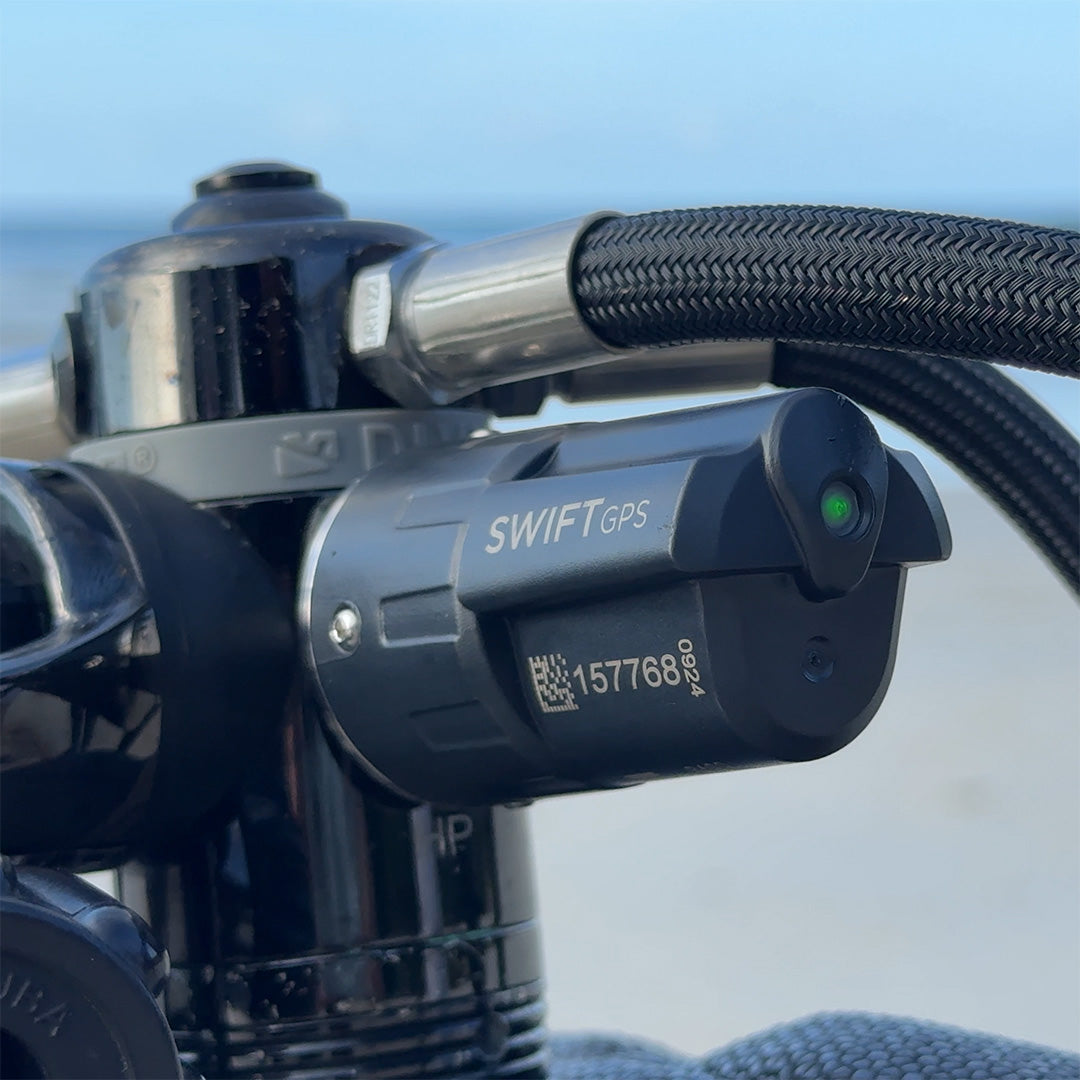
Tank pressure plus location
Adds standard air integration and records surface entry and exit coordinates.

Product overview
Surface coordinates only earn their place if they will be used. For travel, boat, exploration or site-documentation diving, the Shearwater Swift GPS Transmitter can add worthwhile location context to the pressure data already shown on a compatible computer. It is not an automatic upgrade over standard Swift: pressure monitoring remains its primary underwater job, while the added GNSS function extends what can be reviewed after the dive.
At the surface, the transmitter uses GPS, Galileo and BeiDou signals to determine coordinates. Satellite signals do not travel through water, so Swift GPS cannot plot the underwater route. It records entry and exit positions when it has a suitable view of the sky, with accuracy depending on conditions. After the log is transferred to Dive Shearwater, those coordinates can be displayed with location names and mapped dive sites. Compatible Shearwater computers need current firmware for the location functions.
As an air-integration transmitter, it retains Swift's 300-bar pressure rating, 200-metre depth limit and adaptive collision-avoidance timing. One Swift GPS can broadcast its surface location to other compatible computers nearby, while pressure pairing remains part of each diver's own equipment configuration. The approximate one-metre radio range means sensible first-stage placement and wearing the receiving computer on the same side remain important.
The unit fits a compatible 7/16-inch high-pressure port and uses a user-replaceable CR2 lithium battery. Stated endurance is up to 100 dive hours under the specified GNSS-use profile, compared with up to 300 hours for standard Swift. That difference is an important ownership consideration for frequent divers or long trips away from spare batteries.
Swift GPS makes sense when an automatic surface record will improve logbook context, site return planning or trip documentation. Standard Swift is the better buy when cylinder pressure is the only information required; it is less expensive, has longer stated battery life and avoids paying for coordinates that may never be reviewed.
Features
Adds standard air integration and records surface entry and exit coordinates.
Transferred logs can show coordinates, location names and mapped dive sites.
Adaptive timing supports reliable use around multiple transmitters.
User-replaceable power provides up to 100 dive hours under the stated GNSS-use profile.
Highlights
Specifications
Shipping
Included
Learn More
Product help
Complete Your Setup
Expert guidance


